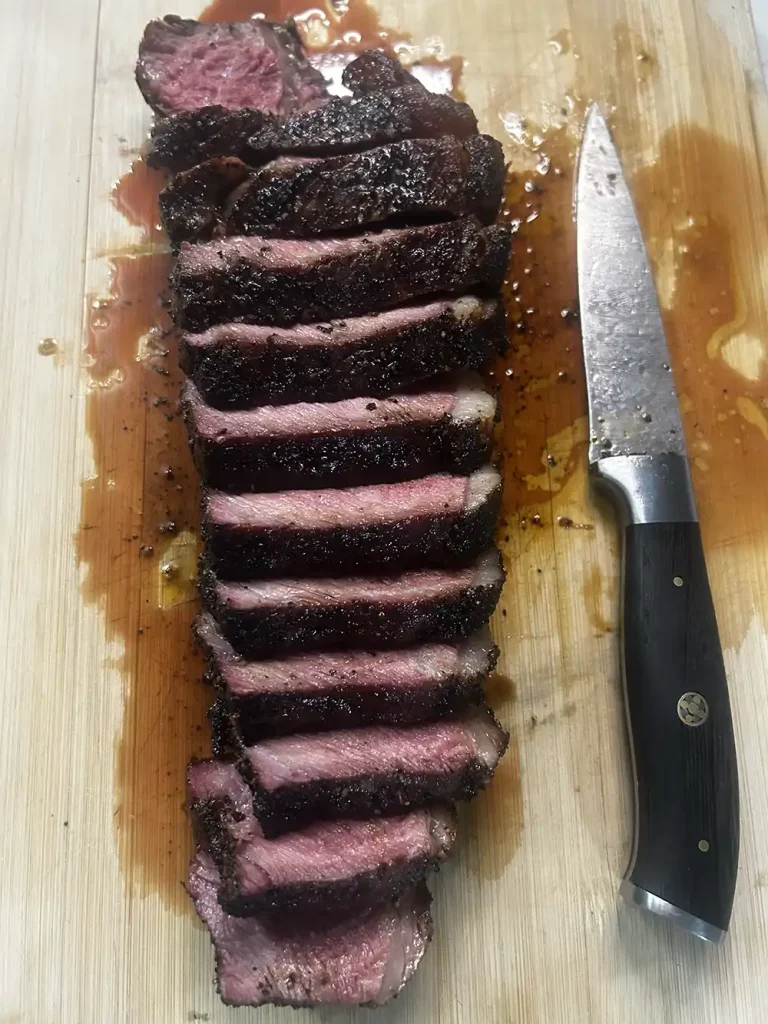
There is a stubborn myth in the outdoor cooking world that you can’t get edge-to-edge pink on a charcoal grill. People think that because charcoal relies on intense radiant heat, you are doomed to a thick, overcooked “gray band” around the edge of your steak by the time the center hits medium-rare.
If you throw a massive, 2-inch thick New York Strip directly over hot coals from the start, that myth becomes a reality.
But in the “Kettle Kitchen” of Northern Michigan, we don’t rely on myths; we rely on thermodynamics. This weekend, I tackled a monster NY Strip using the Reverse Sear method on my 22-inch Weber Kettle, and the result was wall-to-wall, edge-to-edge pink perfection. Here is the “Science-First” breakdown of exactly how to pull it off.
The Prep: Reading Your Rub
Before the meat even saw the fire, we made a crucial technical decision. I used the Morning Woods Double Coffee Texas Rub to build my crust.
- The Science: A lot of my recipes call for a heavy salt dry-brine prior to adding a salt-free coffee rub. However, this specific commercial rub already contains salt in its blend. If I had dry-brined it first, I would have caused an “osmotic overload” and ruined the steak. Knowing your ingredients and skipping the extra salt is the first step to mastering the cook.
Phase 1: The Convection Smoke
To prevent that dreaded gray band, we have to separate our cook into two distinct thermal phases. The first is pure convection.
- The Setup: I configured the Kettle with a 2×1 Snake Method using Kingsford Charcoal. This gave me a slow, highly controlled burn.
- The Cook: I placed the NY Strip on the indirect side and dialed the ambient temperature to a cool, steady 220°F.
- The Milestone: I let it smoke for exactly one hour until the geometric center of the steak hit 110°F. By cooking it this slowly, the internal temperature rises evenly, meaning the outside of the steak is barely hotter than the inside.
Phase 2: The Radiant Sear
Once the steak hit 110°F, I pulled it off the grill and let it rest on a cutting board. Now it was time to change the physics of the Kettle.
- The Fire Adjustment: A 2×1 snake isn’t hot enough to sear. I took my tongs, piled the lit Kingsford coals into a tight, concentrated mound, and took the lid off. By giving the coals maximum oxygen, they rapidly became white-hot.
- The Flame-Kissed Finish: I dropped the steak directly over the raging coals. Because the surface of the steak was already dry from the hour-long smoke, the Maillard reaction was instantaneous. I gave it a quick, aggressive sear on both sides, letting the flames kiss the edges to polymerize that coffee rub into a beautiful, savory crust.
The 10-Minute Momentum Rest
I pulled the steak off the heat and let it rest on the cutting board for 10 minutes before slicing.
- The Science: That massive 2-inch steak had built up significant Thermal Momentum. During the rest, the high-energy exterior transferred its heat inward, gently pushing the center to a flawless 130°F medium-rare. At the same time, the muscle fibers relaxed, locking the juices inside the meat instead of spilling them all over the board.
When I finally sliced into it, there was no gray band. Just a dark, coffee-crusted bark yielding immediately to edge-to-edge pink.
If you want to stop guessing at your steak temps and start engineering perfect cooks like this one, it’s time to start tracking your data.
Master the fire. Trust the science.
— Tom
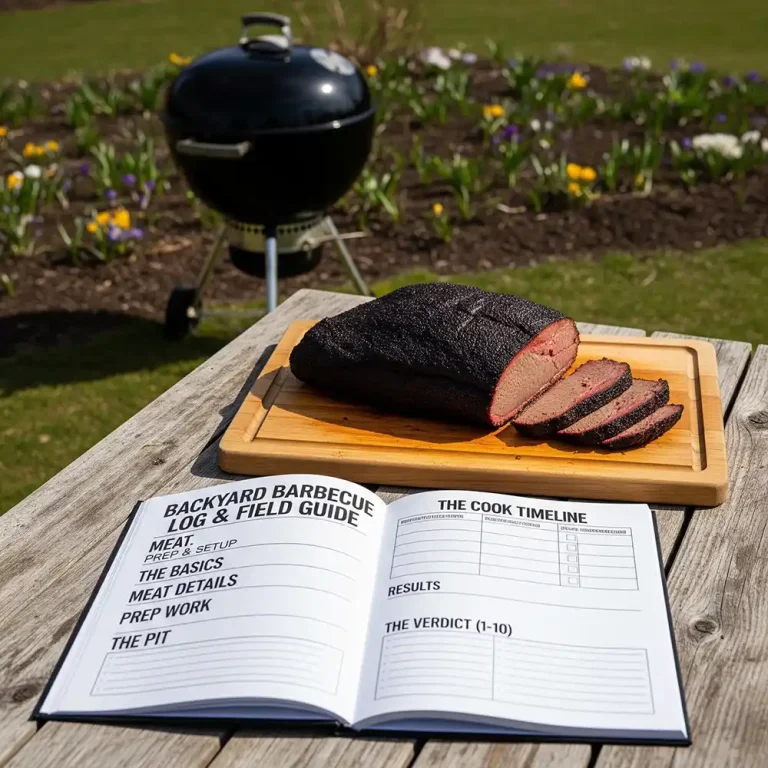
👉 Track your own thermal milestones with the Backyard Barbecue Log and Field Guide on Amazon
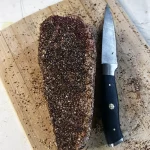
Edge-to-Edge Pink: Reverse Sear Coffee-Rubbed NY Strip
Equipment
- 1 22-inch Weber Kettle Configured for 2-zone indirect cooking using the 2×1 snake method.
- 1 Meat Probe Critical for tracking the 110°F threshold without lifting the lid.
- 1 Kingsford Charcoal Used for both the 220°F steady smoke and the high-heat radiant sear.
Ingredients
- 1 2.25" New York Strip Steak Prime or Choice grade
- 2 tbsp Morning Woods Double Coffee Texas Rub Contains salt, so no extra dry brine is needed.
Instructions
- The Preparation: Apply the Morning Woods Double Coffee Texas Rub heavily to all sides of the steak right before cooking. The Science: Because this commercial blend contains salt, we skip a separate dry brine to prevent osmotic overload and over-salting the meat.
- The Convection Smoke (Phase 1): Set up a 2×1 snake using Kingsford charcoal and add a chunk of Oak wood. Target an ambient Kettle temperature of 220°F. Place the steak on the indirect (cool) side.
- The Extraction Milestone: Smoke the steak for approximately 1 hour until the geometric center reaches exactly 110°F. The Science: Pulling at this low threshold prevents a gray band from forming when we hit the steak with extreme radiant heat in the next phase.
- The Transition & Fire Adjustment: Remove the steak to a cutting board. Use tongs to pile the lit Kingsford coals into a concentrated mound and leave the lid off to maximize oxygen flow until the coals are white-hot.
- The Radiant Sear (Phase 2): Place the steak directly over the raging flames. Sear aggressively for 60 to 90 seconds per side. The Science: The intense infrared heat rapidly triggers the Maillard reaction, polymerizing the coffee rub into a dark crust before the heat can penetrate deep into the meat.
- The Thermal Rest: Remove the steak and let it rest for exactly 10 minutes before slicing. The Science: The thermal momentum built up during the sear will gently push the center from 110°F to a perfect 130°F medium-rare while the muscle fibers relax and retain their juices.
Notes
- Logbook Entry: Record your ambient Kettle temp and the exact time it took for your specific steak thickness to hit 110°F. Log this in your Backyard Barbecue Log and Field Guide to establish a baseline for your next thick-cut steak.
- Sub-Zero Tip: In freezing Michigan temperatures, piling the coals for the final sear is mandatory. A spread-out snake will not generate enough radiant heat to overcome the cold air rushing in when the lid is off.