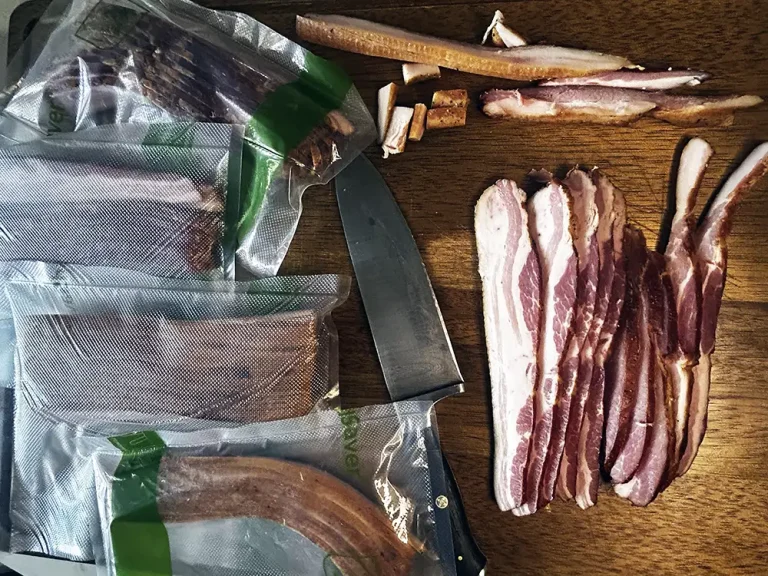
There is a specific kind of satisfaction that comes from slicing into a slab of bacon that you’ve managed from raw belly to cured gold. But doing it in Northern Michigan in February, where the “RealFeel” is fighting to stay above zero, turns a standard cook into a technical operation.
This week, I executed the “Midnight Bacon Protocol.” It wasn’t just about smoke; it was about the chemistry of a 5-day cure and the physics of a 1×1 charcoal snake.
The 5-Day Chemical Transformation
We started Sunday night. This wasn’t just a rub; it was an Equilibrium Cure. By using Curing Salt #1 (Nitrites), salt, pepper, and brown sugar, we spent five days fundamentally changing the structure of the pork belly. The nitrites lock in that vibrant pink color and protect the meat during the long, low-temperature smoke session.
The 1×1 Snake: Low-RPM Mastery
Saturday morning, the mercury was at 8°F. I set up the Kettle with a 1×1 standing snake of B&B Briquettes. This is the “Low-RPM” gear of fuel management. It’s designed to provide the absolute minimum BTU output required to maintain a 200°F environment.
For eight hours, that single row of standing briquettes held the line.
The Tactical Pull at 142°F
In the “Science-First” world, we have to be adaptable. After 8 hours, the internal temp hit a “Thermal Wall” at 142°F. While the target was 150°F, the ambient thermodynamics of a Michigan winter won the final round.
The Decision: I called a “Tactical Pull.” Because the meat was cured and had spent 8 hours in the smoke, it was perfectly safe. Since bacon undergoes a Secondary Cook (the frying pan), pulling at 142°F actually preserved a bit more moisture for the final sear.
The Result: The Best Slice of 2026
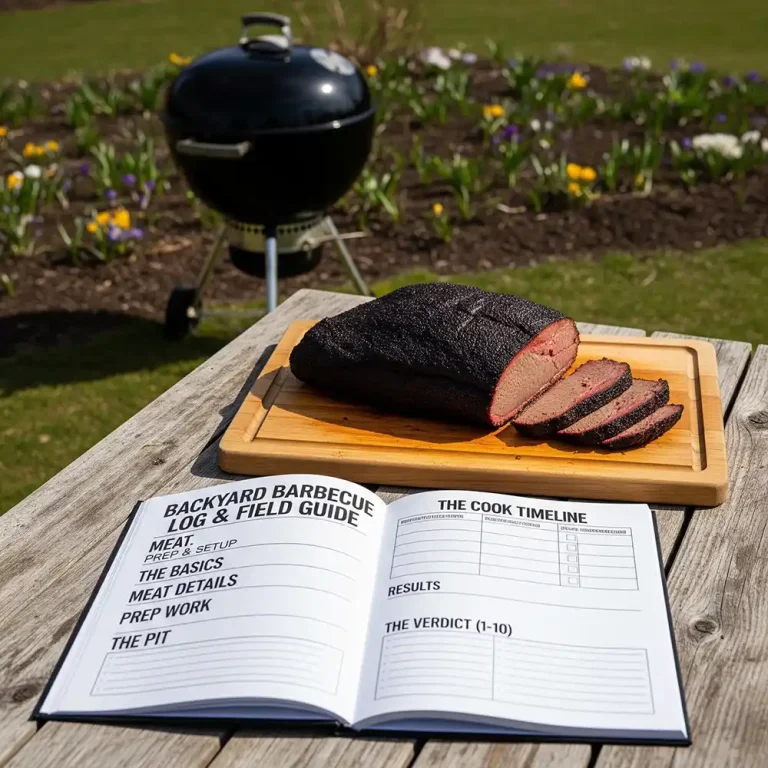
After an overnight chill to solidify the fat, the slicing was effortless. The “Midnight” bark from the coarse pepper and the deep mahogany glow from the 8-hour smoke created a profile you simply cannot buy in a store.
Master the fire. Trust the science. Eat the bacon.
— Tom
👉 Order the Backyard Barbecue Log & Field Guide on Amazon
Smoked Bacon: The 5-Day Sub-Zero Protocol
Equipment
- 1 22-inch Weber Kettle Configured for indirect 1×1 snake method.
- 1 Meat Probe Critical for monitoring the 142°F-150°F
- 1 B&B Briquettes Use the "standing" 1×1 configuration for maximum duration.
- 1 Vacuum Sealer or Ziplock For the 5-day cure phase.
Ingredients
- 5 lbs Pork Belly Skin-off, high-quality fat-to-lean ratio.
- 1 tsb Pink Curing Salt The critical nitrite component for safety and color.
- 2 tbsp Kosher Salt For the osmotic cure.
- .25 cup Brown Sugar To balance the salinity.
- 2 tbsp Coarse Black Pepper Applied as the finishing rub.
- 1 tsp Garlic Powder For the savory baseline.
Instructions
- The Equilibrium Cure: Combine curing salt, kosher salt, and brown sugar. Rub into all sides of the belly. Seal in a bag and refrigerate for 5 days, flipping the bag every 24 hours.
- The Desalination Rinse: On Friday night, remove the belly and rinse thoroughly under cold water. The Science: This removes surface nitrates to prevent a metallic/bitter bark.
- The Pellicle Formation: Place the belly on a wire rack, fat-side down, in the fridge uncovered for 12 hours. The Science: The tacky "pellicle" is a chemical requirement for smoke phenols to adhere to the protein.
- The 1×1 Snake: Arrange briquettes standing vertically in a single row around the Kettle. Light 3-4 coals at the start.
- The Cold Smoke: Place the belly on the indirect side. Aim for 200°F ambient. The Science: Low-intensity heat prevents the fat from liquifying too early, allowing for maximum smoke absorption.
- The Tactical Pull: Pull the meat when the internal temperature reaches 142°F – 150°F. Thermal Milestone: In sub-zero temps, 142°F is the "Tactical Pull" point if the grill loses momentum.
- The Stabilization: Let sit on the counter for 45 minutes, then wrap and chill overnight. The Science: Fat must be below 40°F to achieve clean, geometric slices.
Notes
- Logbook Entry: Record your vent positions for the 1×1 snake in your Backyard Barbecue Log & Field Guide. Note the “Recovery Time” if you opened the lid for probing.
- Sub-Zero Tip: If the ambient temp is below 10°F, position your Kettle behind a windbreak to protect the 1×1 snake from “Convective Heat Loss.”
- Secondary Cook: Always fry or griddle the slices to an internal of 160°F to finish the rendering and crisp the edges.